
In responses to forced displacement – as elsewhere – most donors measure the impact of their interventions through quantitative indicators, outputs and logframes that make it as easy as possible to capture, collate and compare data on the projects they fund. But how far do these technical approaches resonate with people on the ground?
When refugee-led organisations (RLOs) describe the changes they create, the stories they tell – and the language they use – point to deeper transformations that mainstream approaches to measuring impact struggle to surface.
The Asia Pacific Network of Refugees (APNOR) and ODI Global’s two-year research project evidencing the impact of RLOs is still in its infancy. But early indications suggest that, beyond ‘reporting differently’, RLOs are advancing a deeper understanding of what meaningful impact can and should look like.
Putting community at the centre
Established by APNOR in 2021, the Refugee Leadership Alliance is the Asia-Pacific Region’s first and only refugee-led fund and initiative dedicated to providing direct unrestricted funding, expanding networks, building capacity and amplifying the influence of refugee leaders and refugee-led organisations across the region.
APNOR’s direct investment in RLOs through the Refugee Leadership Alliance has indirectly generated a growing body of evidence on how RLOs understand, create and report on impact. Our analysis of reports submitted to APNOR by RLOs that have received grants through the Alliance uncover several patterns in reporting. Analysing these reports provides an opportunity to rethink how impact itself is defined and assessed within refugee responses.
A basic word frequency analysis (see below) reveals that ‘community’ is the most frequent word used by RLOs in their reporting: the word features on average 20 times per report, more often than either ‘project’ or ‘refugee’. Reinforcing this emphasis on collective change, ‘social’ emerges as the most prevalent adjective.
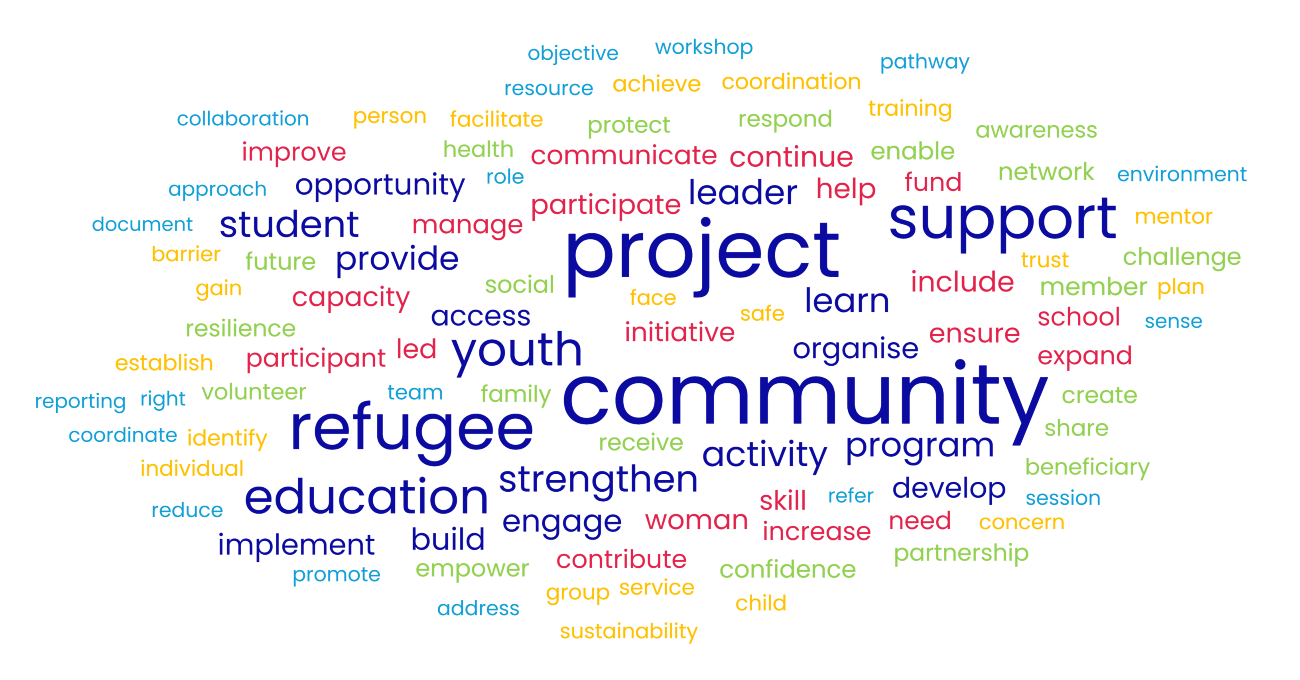
RLOs’ reporting language also emphasises communities’ existing capacity and resilience – positioning RLOs as amplifiers rather than providers and putting communities (rather than RLOs) at the centre. Instead of ‘provide’ or ‘deliver’, the most prominent verb in the reports is ‘strengthen’.
The following quotations from RLOs in Thailand, Japan and Bangladesh illustrate how this language translates into final reports:
‘These activities […] strengthened their sense of community spirit, leadership and social responsibility. Participants were empowered and motivated to actively contribute to positive community development initiatives.’ – A refugee-youth led organisation operating in South East Asia
‘By providing educational opportunities, social support and community engagement, the project helped strengthen resilience among refugee families and promoted a more supportive and empowered community environment.’ – Harmony Sisters, a refugee women-led organisation operating in Japan
‘The project enabled beneficiaries to transition from passive recipients of assistance to active contributors within our communities. Additionally, trained youth demonstrated increased confidence, responsibility, and initiative, actively supporting community activities and positive social changes.’ – Rohingya Youth Network, based in Cox’s Bazaar refugee camp, Bangladesh
Layering the tangible with the intangible
When it comes to impact, another striking detail that emerged from our analysis of RLO reports is their dual focus on:
- Measurable outputs and outcomes – such as participants reached, activities delivered and services provided.
- Deeper impacts that are less tangible and harder to measure – such as greater confidence, belonging, dignity, leadership, resilience and community relationships.
As expressed in the following quotes, RLOs are reporting on their own successes, but also building a case for an alternative understanding – and evaluation – of impact.
‘Success was reflected not only in outputs, but in increased self-confidence, emotional resilience, and participants’ ability to contribute to their communities.’ – Emplace Youth Initiative, an RLO working with youth in Indonesia
‘Literacy opened doors not only to knowledge but to self-worth, protecting girls from early marriage and giving them the foundation to imagine a future beyond survival.’ – RLO in Cox’s Bazar refugee camp, Bangladesh
‘We hosted 51 community lunches, with an average attendance of 35 people per session. These lunches were more than just meals. They provided a regular space for cultural exchange and solidarity. […] This built a stronger sense of community identity, rooted in empathy, shared experiences, and mutual care.’ – Humanity Seekers, a refugee-led organisation in Hong Kong
Finding a shared definition
This dual or layered approach mirrors official OECD definitions that situate impact within higher-level effects:
‘Impact: The extent to which the intervention has generated or is expected to generate significant positive or negative, intended or unintended, higher-level effects. […] Impact addresses the ultimate significance and potentially transformative effects of the intervention. […] It does so by examining the holistic and enduring changes in systems or norms, and potential effects on people’s well-being, human rights, gender equality, and the environment.’ – OECD
But if RLOs are already doing it, why is this not systematically reflected in donors’ approaches to measuring impact? We’ll be exploring this question as our research progresses. But one rationale is that complex indicators of impact are harder to capture within traditional funding cycles – motivating donors to prioritise immediate results using standardised metrics.
By privileging what is immediately measurable over what is socially transformative, donor reporting frameworks risk overlooking many of the outcomes RLOs consistently identify as their greatest achievements. A shared approach to impact should take into consideration both immediate outcomes and longer-term dimensions of change.
Time to flip the narrative
RLOs don’t have an impact problem – they have an evidencing problem. The challenge is ensuring that donor systems evolve to better recognise the kinds of impacts that RLOs are already achieving. Through our APNOR–ODI Global partnership, together with refugee leaders and donors, we hope to shape approaches to impact that better reflect the realities of refugee leadership and the lasting transformations these organisations create.

Najeeba Wazefadost
Founder & Chief Executive Director, Asia Pacific Network of Refugees (APNOR)